Blog - Contract to Hire vs Direct Hire: The Complete Hiring Guide

If you’re trying to scale your team, stay flexible, or simply hire smarter, you’ve probably run into two common options: contract to hire vs direct hire.
But which one actually makes sense for your business? And how do top-performing teams decide between the two?
In this complete guide, created by PeopleSolutions, we’ll break down the differences, clear up common misconceptions, look at what the data says, and help you make hiring decisions that actually move your business forward.
Let’s jump in.
What “Direct Hire” Really Means
A direct hire is the traditional approach to hiring. Someone applies, you hire them, they join payroll, and they immediately become a permanent member of your team. They receive benefits (if provided), join the culture from day one, and typically have more job security.
Companies use direct hire when they know the role is long-term, core to operations, and worth investing in. It’s the model that supports continuity, institutional knowledge, and culture-building.
What “Contract to Hire” Really Means
A contract to hire role (also called “temp-to-perm”) works differently. A worker begins as a contractor for a set period, often three, six, or nine months. After that, the employer may extend an offer to convert them to full-time.
This structure lets employers evaluate job performance, skills, and cultural alignment before committing. It also gives employees a chance to experience the environment before going full-time.
For companies operating in fast-moving industries or navigating uncertain forecasts, contract to hire offers a low-risk, highly flexible way to adjust staffing levels.
Why Contract to Hire Has Become More Popular
The world of work has changed dramatically over the last decade. Today, flexible staffing models aren’t just “nice to have”; they’re becoming standard.
The Rise of Contingent Work
According to the U.S. Bureau of Labor Statistics, 4.3% of U.S. workers held contingent (temporary or non-long-term) roles in July 2023, up from 3.8% in 2017.
Growth in Alternative Work Arrangements
The BLS also found that:
- 7.4% of workers were independent contractors
- 0.6% worked through temporary help agencies
- 0.5% were employees of contract firms
Industry-Specific Growth
Research published through the National Bureau of Economic Research shows that in U.S. manufacturing, the share of contract workers in core occupations jumped from 1.7% in 1990 to 10% in 2015.
These shifts show that contract work is now a mainstream workforce strategy.
And that’s exactly why more organizations are using contract to hire as a middle path between flexibility and long-term team building.
Contract to Hire vs Direct Hire: How They Compare
To understand when to use each, let’s break down the strengths and trade-offs.
Advantages of Direct Hire
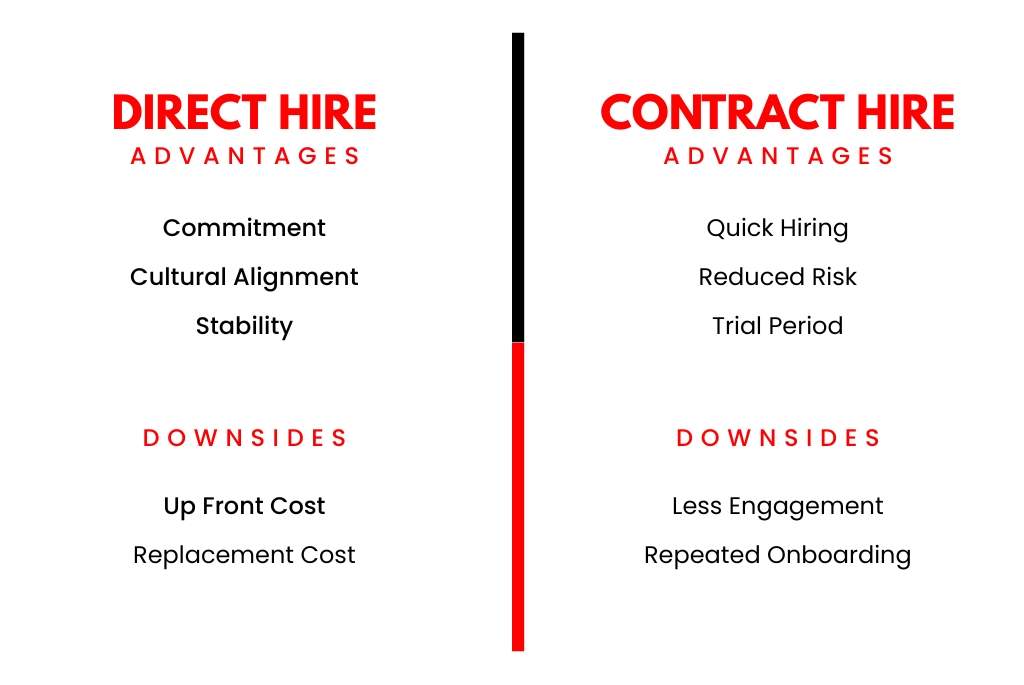
Direct hire is ideal when you want commitment, stability, and long-term cultural integration. It’s a strong strategy for building institutional knowledge and ensuring continuity across teams.
The major benefit? You can invest in employees more confidently because you know they’re a permanent part of the team.
However, it comes with higher upfront costs (benefits, onboarding, training) and if the hire doesn’t work out, replacing them can become expensive. According to the U.S. Department of Labor, the cost of a bad hire can reach 30% of the employee’s first-year earnings.
Advantages of Contract to Hire
Contract to hire reduces risk dramatically. Employers can evaluate real-world performance before offering full-time employment, and they gain flexibility during uncertain periods or fluctuating workloads.
It’s also faster. You can onboard contractors quickly, especially through a staffing partner like PeopleSolutions.
The downside? Contractors may initially engage less or feel less connected to company culture, and onboarding may need to be repeated when they convert to full-time.
Still, in many cases, the benefits outweigh the drawbacks; especially for project-based, evolving, or high-variability work environments.
When Contract to Hire Makes the Most Sense
There are plenty of situations where contract to hire is the smarter move. Here are a few of the most common:
- When you expect workload fluctuations, such as project-based cycles or seasonal surges.
- When the company wants to test performance, communication, and cultural alignment before committing.
- When your organization needs speed but doesn’t want to immediately add a long-term headcount.
- When budget approvals or strategic planning timelines create short-term uncertainty.
This model gives companies breathing room to make the right decision without rushing a hire they may regret.
When Direct Hire Is the Better Choice
There are also plenty of cases where direct hire is the stronger option. Most commonly:
- When the role is mission-critical, strategic, or central to long-term success.
- When you need a hire to contribute to culture, continuity, and institutional memory.
- When you want the employee to feel fully included from day one, with immediate access to benefits and long-term career opportunities.
- When the role requires trust, confidentiality, or leadership responsibility.
In short: if you’re building the foundation of your workforce, direct hire is usually the right way to go.
What the Data Tells Us About Today’s Workforce
Flexible work isn’t just growing; it’s restructuring entire industries.
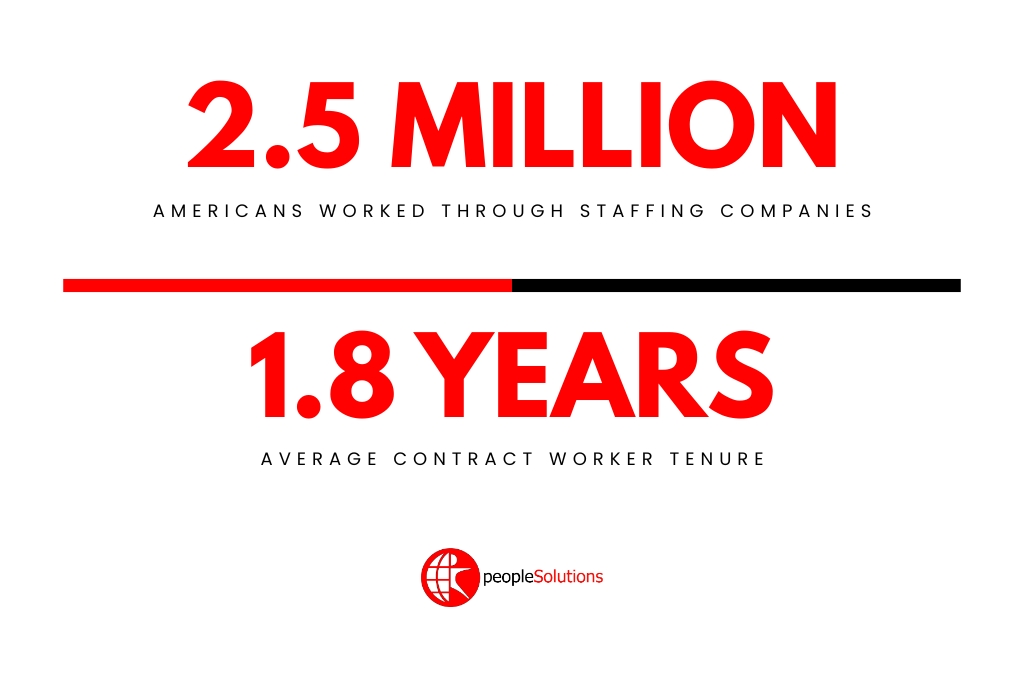
For example, in 2023 a weekly average of 2.5 million Americans worked through staffing companies. While that figure includes both temporary and contract work, it highlights the scale and staying power of alternative employment models.
And when workers do take contract roles, they often stay longer than expected. Research from Zippia found that the average contract worker tenure is 1.8 years, which counters the perception that contract roles are always short-term or unstable.
These trends reinforce one thing: contract to hire is now a critical part of modern workforce planning.
Myths About Contract to Hire (And the Truth Behind Them)
There’s a lot of confusion about contract to hire, so let’s clear up some misconceptions.
Myth #1: Contract to hire is only for low-skill jobs.
Not true. The alternative workforce now spans highly skilled and technical roles across engineering, IT, logistics, healthcare, and more. Even professional sectors like accounting and project management have rising contract to hire usage.
Myth #2: Contractors don’t care about the company’s success.
Many contractors actively want stability and long-term employment but prefer a trial period before committing. And because they know their potential conversion depends on performance, many work even harder to make an impact.
Myth #3: Direct hire is always cheaper.
Direct hires can be cost-efficient in the long-term, but high turnover is expensive. And as the DOL estimates, a bad hire may cost 30% of first-year earnings. Contract to hire dramatically reduces this risk by giving both sides a trial run.
Myth #4: Contracting hurts culture.
It can, if poorly managed. Companies like PeopleSolutions build processes for smooth integration, proper onboarding, and clear expectations. When executed well, contract to hire enhances culture by reducing mismatches and improving long-term retention.
How PeopleSolutions Helps Improve Contract to Hire Placements
Companies don’t just want workers; they want the right workers, at the right time, for the right roles.
PeopleSolutions supports this by:
- Speeding up hiring through a deep talent network.
- Reducing risk via contract to hire evaluations.
- Helping companies scale flexibly during uncertain market conditions.
- Improving matching accuracy so clients ultimately convert stronger long-term hires.
Whether a company is growing, stabilizing, or reorganizing strategy, PeopleSolutions can recommend the model that fits best.
A Practical Framework for Choosing Between Contract to Hire and Direct Hire
If you’re still unsure which hiring model to use, this simple framework helps teams make the decision:
-
Identify the role horizon
Short-term or project-based → contract to hire
Long-term, strategic → direct hire
-
Consider the level of risk tolerance
Uncertain performance or fit → contract to hire
High confidence in role and candidates → direct hire
-
Evaluate timeline and urgency
Need someone immediately → contract to hire
Time for a full recruitment cycle → direct hire
-
Review budget structure
Uncertain budgets → contract to hire
Dedicated full-time funding → direct hire
This approach helps teams make data-informed hiring decisions.
Hybrid Workforce Strategies: Why Many Companies Use Both
Most growing organizations don’t choose direct hire or contract to hire. They use both.
Here’s why the hybrid model works so well:
- It allows you to build a stable core team using direct hires.
- It adds a flexible outer layer of contract to hire or contract only workers to meet changing demand.
- It supports faster innovation, because companies can add specialized skills quickly without long-term commitments.
- It reduces hiring mistakes through real-world evaluation before converting contractors to permanent staff.
This model is extremely common in tech, engineering, logistics, finance, and healthcare; industries that value agility without sacrificing quality.
Final Thoughts: Which Hiring Model Is Right for You?
Choosing between contract to hire and direct hire isn’t about picking a “better” model. It’s about choosing the right strategy for your goals, budget, and timeline.
Use contract to hire when you want flexibility, speed, and lower risk.
Use direct hire when you want stability, long-term culture alignment, and deeper organizational investment.
Both approaches can transform your workforce, but only if you choose the model that fits your business needs today and your growth plans for tomorrow.
With PeopleSolutions as your hiring partner, you don’t have to make that decision alone. Their expertise ensures you use each model strategically, so you can build a workforce designed for both performance and longevity.
