Blog - Contract Staffing Model Comparison: 5 Models That Get Confused (and Why It Costs You)
The phrase “contract staffing” gets thrown around like everyone means the same thing. They don’t.
Ask five hiring managers what it means, and you’ll get five different answers. One thinks temporary workers. Another assumes outsourcing. A third pictures consultants on defined projects. When you misidentify which model you’re using, budgets blow up and delivery timelines slip.
This article breaks down five workforce models that get lumped under “contract staffing”: staff augmentation, Statement of Work (SOW), contract-to-hire, temporary placements, and outsourced delivery. Each operates differently. Each fails differently. Treating them as interchangeable derails projects before they start.
What We Mean by Contract Staffing (And Why the Term Hides More Than It Reveals)
Contract staffing covers multiple labor models that differ in who controls the work, who owns outcomes, and where risk sits.
The Bureau of Labor Statistics tracks contingent workers, lumping independent contractors, on-call workers, temp agency staff, and contract employees into broad categories. This ambiguity carries into how companies talk about staffing.
When a manager says they need “contract staff,” what are they requesting? Someone reporting to them daily? A team delivering a finished product? A trial before full-time hire? Without shared vocabulary, procurement pulls one lever while operations expects another.
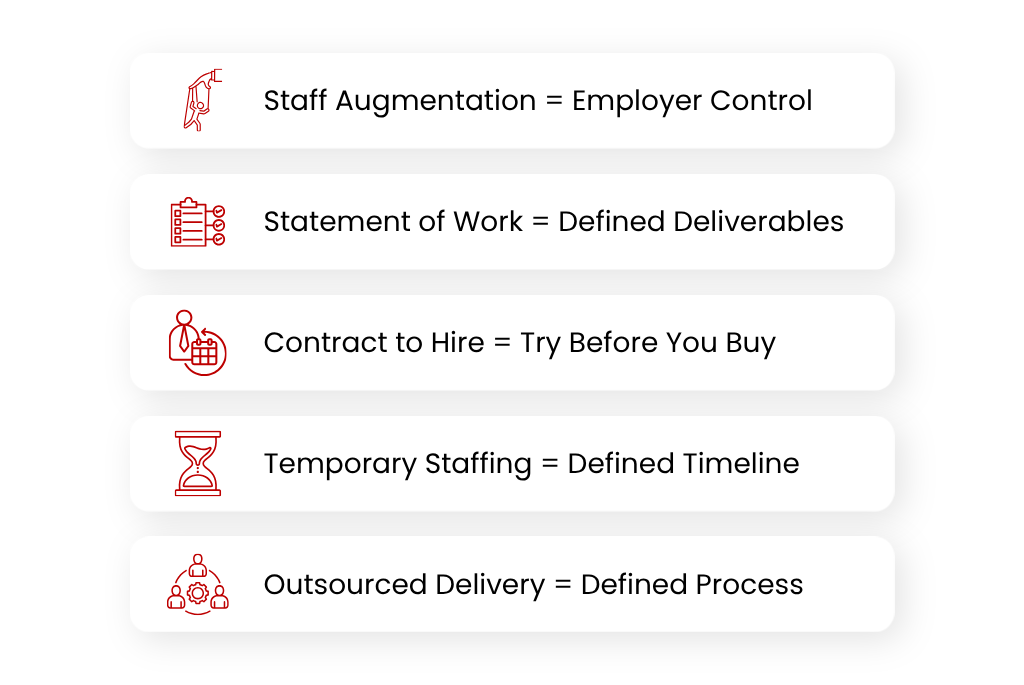
The taxonomy matters because each model distributes control and accountability differently. Staff augmentation puts workers under your management. SOW arrangements hand deliverables to vendors. Contract-to-hire provides a probationary period. Treating these as fungible leads to governance gaps and cost overruns.
Model 1: Staff Augmentation
What It Actually Is
Staff augmentation (staff aug) integrates external professionals into your team under your direct management. You control tasks and priorities. The staffing firm handles payroll, but managerial authority stays internal.
How Staff Augmentation Fails
Internal managers assume someone else owns delivery because they’re paying a vendor. They don’t. Bring in developers via staff aug and treat them like managed services? Nobody on the vendor side manages scope. You’ve added headcount without the management layer to make it productive.
Companies also use staff augmentation to patch weak leadership. If your managers can’t direct work effectively, adding contractors makes it more expensive.
When to Use Staff Augmentation
Staff augmentation works with strong internal management and specific skill needs. Team leads know what needs doing and can onboard quickly. The work is modular enough for external contributors to plug in.
Good fit: scaling a development team where your tech lead manages the roster. Bad fit: hoping contractors “figure it out” without dedicated oversight.
Model 2: Statement of Work (SOW) / Service Procurement
What It Actually Is
An SOW is a deliverables contract. You’re buying outcomes, not renting headcount. The vendor defines execution. You specify success, set milestones, and evaluate deliverables.
In staff augmentation, you assign daily tasks. In SOW, the vendor owns execution. You approve or reject what they deliver.
How SOW Contracts Fail
SOW fails when buyers micromanage execution. Paying for deliverables but dictating staffing and tools undermines the model. Vendors can’t own outcomes if you control inputs.
Scope creep kills the rest. Loosely defined SOWs become endless revisions. If the final product isn’t specified, every iteration becomes a negotiation.
Industry experience and contingent workforce analyses indicate that a significant portion of Statement of Work engagements (commonly cited above 20 %) are misclassified staff augmentation work, leading to inflated costs when managed as services rather than labor capacity.
When to Use SOW Procurement
Use SOW when you can define needs and evaluate quality independently. Work should be bounded with objective acceptance criteria.
Custom software with defined specs? SOW works. “Some design help” without clear deliverables? You’re setting up for conflict.
Model 3: Contract-to-Hire (C2H)
What It Actually Is
Contract-to-hire is trial before commitment. Workers start as contractors for three to six months, with a path to permanent employment if both sides agree. You assess fit before making a full-time offer.
How Contract-to-Hire Fails
C2H fails when employers treat it as “temporary labor with benefits later.” If conversion timelines shift or expectations are vague, you lose good people.
Integration matters too. Exclude C2H workers from planning or resources, and you can’t assess cultural fit. You need integration to evaluate it.
The benefits gap also breeds resentment when trials stretch beyond a few months.
When to Use Contract-to-Hire
Contract-to-hire works when cultural alignment matters as much as technical skills. You’re hiring for permanence but want validation.
It’s useful when credentials don’t tell the full story. A developer might look great on paper but clash with your communication style. C2H tests these dynamics before locking in.
Model 4: Temporary / Agency Placement
What It Actually Is
Temporary staffing is short-term employment through an agency that handles payroll, taxes, and compliance. You get labor without adding a headcount.
The American Staffing Association reports temps make up about 1.5% of U.S. employment, with most assignments lasting weeks or months.
How Temporary Staffing Fails
Failure happens when temporary becomes indefinite. A three-month assignment becomes twelve. You’ve created hidden dependency without commitment.
This creates turnover churn. Good temps leave for permanent roles. You’re constantly onboarding replacements and losing productivity. Temps who stay too long feel like second-class employees which hurts morale and performance.
When to Use Temporary Staffing
Temporary staffing works for episodic needs: covering maternity leave, seasonal rushes, six-week projects that don’t justify hires.
Work should be well-defined and time boxed. If you’re thinking “we’ll need this indefinitely,” you’re avoiding a hiring decision.
Model 5: Outsourced Delivery
What It Actually Is
Outsourced delivery hands full accountability to an external vendor. You’re buying completed work. The vendor controls staffing, methodology, and execution. You define requirements and evaluate outcomes.
This differs from SOW in duration. SOWs are project-based. Outsourcing can be ongoing: your entire customer support, IT infrastructure, or content production.
How Outsourced Delivery Fails
It fails when companies want vendor accountability but micromanage. Dictating how, when, and who works negates the model.
Another breakdown: governance that doesn’t match the relationship. You need clear SLAs, metrics, and escalation paths. Without these, accountability becomes murky.
Knowledge transfer problems also emerge. Outsource without documenting processes, and vendors operate in black boxes. Quality gets inconsistent.
When to Use Outsourced Delivery
Works when outcomes are measurable and internal management bandwidth is limited. You can evaluate objectively and will cede control for reduced overhead.
Good for repeatable processes with clear standards. Customer support with service level agreements (SLAs). Payroll with accuracy requirements. These work through metrics rather than direct supervision.
Why Mixing Up These Models Wrecks Projects
When organizations treat these models as interchangeable, failure becomes predictable.
Engage a vendor for SOW but manage them like staff augmentation? You’re paying premium rates while doing all the management. Costs double without better outcomes.
Bring in staff augmentation but assume the vendor owns delivery? Your managers think someone else is driving. The firm thinks they’re providing bodies. Nothing gets delivered.
Budget overruns follow. You scope based on one model, execute with another. Staff aug priced for direct management becomes expensive when you need vendor oversight.
Governance gaps emerge. Staff aug needs active internal management. SOW needs acceptance criteria. Outsourcing demands SLAs. Wrong governance means accountability evaporates.
A Decision Framework That Actually Works
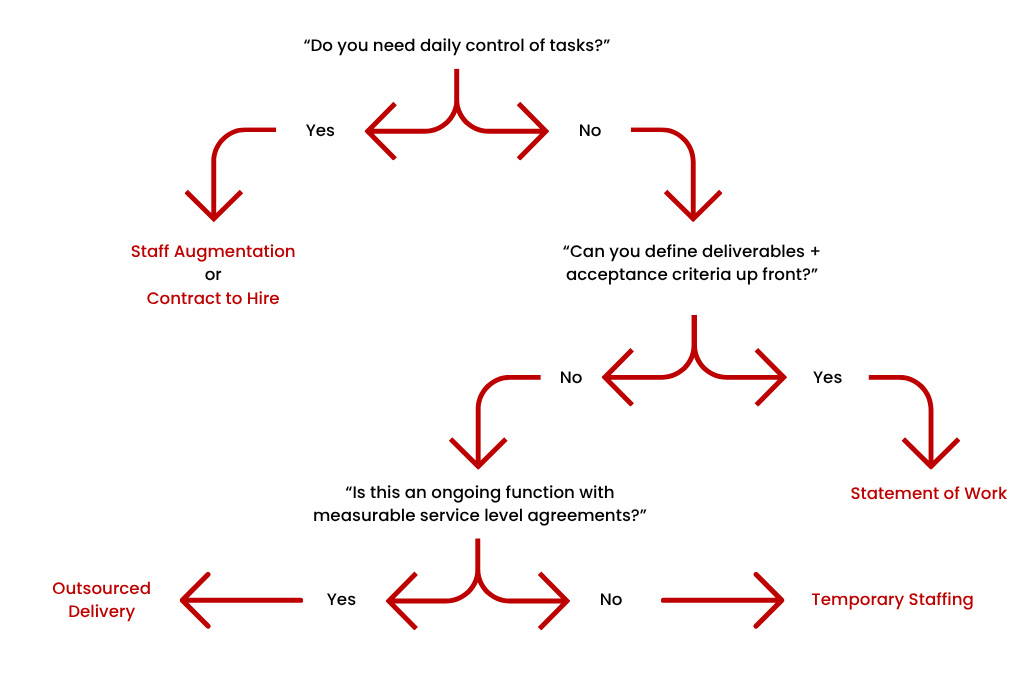
Choose based on three factors: who controls work, how clearly outcomes are defined, and integration needs.
Control spectrum: Need direct control? Staff augmentation. Can you evaluate finished deliverables? SOW or outsourcing. Contract-to-hire and temp placements fall in between.
Scope clarity: Undefined work needs staff augmentation where you redirect as requirements emerge. Well-defined deliverables support SOW. Outsourcing requires the clearest scope.
Integration needs: Work coupled with internal systems needs staff aug or contract-to-hire. Independent work with clean handoffs can be SOW or outsourced. Temps work for lightly integrated tasks.
Risk tolerance: Maximum flexibility? Staff augmentation. Predictable costs? SOW. Outsourcing shifts execution risk. Contract-to-hire mitigates hiring risk. Temps minimize commitment risk.
If you need daily control over evolving requirements, don’t sign an SOW. If you want finished deliverables without managing work, don’t bring in staff augmentation.
Getting the Model Right from the Start
The contract staffing landscape isn’t complicated once you stop using one term for five different things. Each model serves specific needs, carries different risks, and requires different management.
Staff augmentation gives flexible capacity under your control. SOW procurement buys defined deliverables. Contract-to-hire provides trial runs before permanent commitment. Temporary placements cover short-term needs. Outsourcing delegates ownership when you can’t or don’t want to manage directly.
Choose based on control needs, outcome clarity, and integration requirements. Match governance to the relationship you actually have, not the one you wish you had.
When hiring managers, procurement, and finance all know which model is being used, projects run smoother, budgets hold and delivery happens. The clarity compounds as your organization builds better sourcing practices.
If you’re evaluating contract staffing for an upcoming project, start by asking which of these five models matches your needs. The answer saves time, money, and frustration.
Want help figuring out which contract staffing model fits your situation? PeopleSolutions specializes in matching companies with the right workforce strategies. Reach out today to start the conversation.
