Blog - Contract to Hire Transition: Timing, Negotiation & Expectations

The contract to hire model has become a powerful pathway for modern professionals, especially those who want to test-drive a role, evaluate company culture, or transition into full-time employment without guesswork. But while the structure gives both sides flexibility, the conversion process itself can feel murky.
What happens next? When should you discuss salary? How do you set the right expectations about workload, benefits, or ongoing responsibilities?
In this comprehensive guide, we break down exactly how to navigate the contract to hire transition; from understanding timing, to approaching renegotiation, to asking the right questions so you enter your full-time offer with clarity and confidence.
Why Companies Choose Contract to Hire
Before you map out your own conversion strategy, it helps to understand the employer’s perspective. Companies typically use contract to hire arrangements to:
- Evaluate fit before committing to a full-time hire
- Accelerate hiring during growth periods
- Reduce risk and turnover
- Fill roles quickly while assessing long-term needs
- Test new functions or team structures
From your perspective, the model offers a valuable advantage: the chance to “audition” the company as much as they’re evaluating you.
Understanding the Contract to Hire Timeline
Every company structures contract to hire timelines differently, but most fall into one of three formats:
Fixed Timeline (Most Common)
Examples: 3 months, 6 months, or 1 year.
The employer agrees to make a decision by a specific date, assuming performance and budget remain strong.
Flexible Timeline
“Let’s see how the project evolves.”
Here, performance and business need to dictate timing. This format requires more proactive communication.
Milestone-Based Timeline
The conversion occurs once certain results are achieved; finishing a project, hitting KPIs, or onboarding a new system.
How to Know You’re Approaching the Offer Window
Watch for these signals:
- You’re invited to more strategic meetings
- Leadership begins discussing long-term projects with you
- You gain responsibilities that extend beyond the contract scope
- HR checks in more frequently
- You’re asked for input on team planning, budgeting, or workflows
When these signs appear, it’s time to prepare for renegotiation. This includes understanding your value and researching comparable salaries.
Preparing for the Conversion: What to Gather
Before discussing your full-time offer, you should assemble the following:
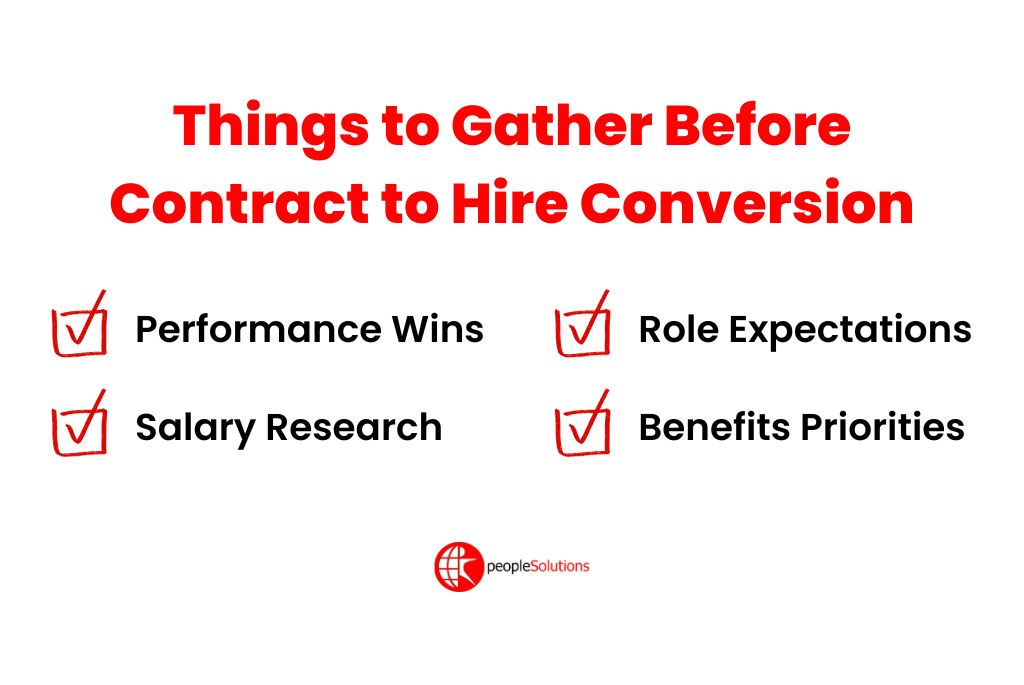
Performance Wins
Collect measurable achievements:
- Projects completed
- Revenue or efficiency impact
- Accuracy or error reduction
- Positive client or team feedback
Updated Salary Research
This is crucial for a contract to hire salary negotiation. Use reliable data sources such as:
Clarified Role Expectations
Sometimes the job evolves during contract work. Document the tasks you actually perform because these influence your full-time title and compensation.
Benefits Priorities
If you did not have benefits during your contract period, full-time conversion often adds:
- Health insurance
- Retirement match
- Paid time off
- Bonus eligibility
- Educational reimbursement
Find out what your company offers and know what matters most before renegotiation begins.
How to Navigate the Offer Conversation with Confidence
The conversion conversation usually happens with your immediate supervisor and/or HR. Here are the core elements.
Start with Alignment
You want to reinforce collaboration. For example, you could say something like:
“I’ve really enjoyed contributing to the team and would love to continue growing with the company. I’m glad we’re discussing conversion, and I want to make sure we’re aligned on expectations and compensation for the full-time role.”
Clarify the Role First
Before talking compensation, confirm:
- Responsibilities
- Long-term expectations
- Leadership opportunities
- Workload changes
- Whether your title will change
You cannot accurately negotiate salary until the role is clearly defined.
Present Your Case Professionally
Base your negotiation on value delivered, not personal need.
Example structure:
- “Here are the results I’ve delivered so far…”
- “Here’s how my responsibilities have expanded…”
- “Here’s what similar full-time roles are paying in today’s market…”
- “Based on that, here’s the range I believe aligns with the role.”
This creates a data-backed, confident, professional approach for contract to hire salary negotiation conversations.
Be Mindful of Benefits
Your hourly contract rate may not be comparable to your salaried rate.
Full-time employment often includes:
- PTO
- Insurance
- Employer-paid taxes
- Holiday pay
These benefits add value even if the base salary appears slightly lower.
Ask About Next Steps
Before ending the conversation, confirm:
- Who approves the offer
- What the timeline looks like
- Whether there are additional interviews
- When to expect paperwork
Clarifying these details prevents unclear waiting periods.
Common Questions Candidates Should Ask During the Contract to Hire Conversion
Candidates often underestimate the importance of asking the right questions. These not only clarify expectations but also signal professionalism and preparedness.
Here are the most strategic questions to ask:
Role & Expectations
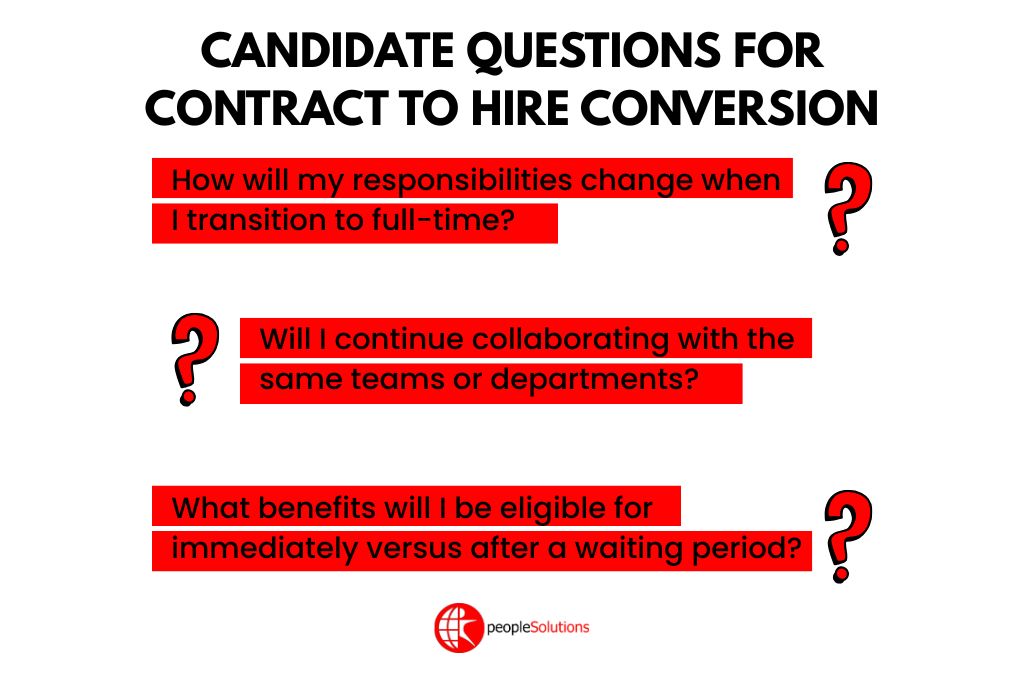
- How will my responsibilities change when I transition to full-time?
- Will my job title remain the same or be reclassified?
- What are the performance expectations for the first 90 days?
- What long-term goals will I be evaluated on?
Team & Reporting Structure
- Who will I report to in the full-time role?
- Will I continue collaborating with the same teams or departments?
- Are there any organizational changes expected in the next year?
Compensation & Benefits
- What is the salary range for the full-time position?
- Are bonuses or incentive programs available?
- What benefits will I be eligible for immediately versus after a waiting period?
- If applicable: How does overtime work once I become full-time?
Work Flexibility & Culture
- What is the company’s policy on remote or hybrid work?
- Is there a professional development or training budget?
- What does long-term career growth look like at this company?
Timeline & Process
- What are the next steps in the conversion process?
- When should I expect to receive the written offer?
- Is there anything else you need from me at this stage?
Asking these questions sets you up for success and makes the transition smoother for both sides.
How to Handle Renegotiation Without Tension
Negotiation can feel intimidating, but it’s a normal, expected part of the contract to hire journey. Here’s how to handle it professionally.
Keep Emotion Out of It
You’re negotiating for fair compensation, not making a personal request.
Use Market Data to Support Your Ask
“Based on my research, similar roles in this region fall between X and Y.”
Anchor the Conversation Around Responsibility, Not Tenure
Avoid:
“I’ve been here six months, so I think I deserve…”
Try instead:
“In addition to my original duties, I now manage X, Y, and Z, which align with mid-level responsibilities.”
Leave Room for Flexibility
Give a salary range not a single number.
If the Offer Is Low, Ask Follow-Up Questions
Examples:
- “Can you help me understand how the salary was determined?”
- “Is there room for review in 6 months?”
- “If salary is capped, are additional benefits negotiable?”
Setting the Right Expectations for the Future
The contract to hire conversion is only the beginning. Once you transition to full-time, consider discussing:
- Career path opportunities
- Mentorship or leadership development
- Training resources
- Performance review cycles
- Long-term project involvement
This ensures you start your permanent position with clear goals for the future and momentum.
Signs the Contract to Hire Role Is a Good Fit Long-Term
As you approach conversion, take time to evaluate:
- Do you feel supported by leadership?
- Does the workload match what you want in the long-term?
- Is the company culture healthy and collaborative?
- Are growth opportunities available?
- Do you want to stay beyond the transition?
Contract to hire isn’t just an employer trial; it’s your trial too.
Final Thoughts: Approach the Transition with Prepared Confidence
The contract to hire transition doesn’t have to be uncertain, uncomfortable, or rushed. With the right preparation of performance documentation, market research, strategic questions, and clarity around expectations, you can step into renegotiation and conversion with confidence.
Whether you’re entering discussions about role changes or preparing for meaningful contract to hire salary negotiation, this is your moment to advocate for the value you’ve proven.
Your next step is simple: prepare early, communicate clearly, and treat the conversion as a collaborative, not confrontational, process. You’ve already shown what you can do; now make sure your full-time offer reflects it.
