Blog - Contract Staffing Trends in the U.S. Workforce (2026 Report)

TL;DR
Contract staffing in 2026 has become a planned workforce strategy that helps companies control labor costs, hire faster, access specialized skills, and stay flexible in uncertain markets. Employers are using shorter, more tightly scoped contracts for higher-skill roles, while remote work has widened the talent pool and increased competition. At the same time, compliance risks around worker classification are pushing more companies to rely on staffing partners or employers of record. For workers, success depends less on titles and more on proven results, specialized skills, and repeat engagements. The core message is simple: contract staffing now rewards precision, speed, and realistic planning from both employers and contractors.
Introduction
Contract staffing in the United States has shifted from a reactive staffing tactic to a deliberate workforce strategy. Currently, companies use contract labor to control costs, manage uncertainty, and access skills they cannot justify hiring permanently. For contract workers, these shifts determine pay stability, demand cycles, and how careers are built outside traditional employment.
This report explains the contract hiring staffing shaping the U.S. workforce in 2026. It focuses on what is changing, why it is happening, and how those changes affect employers and workers in practical terms.
What Contract Staffing Means In 2026
Contract staffing refers to engaging workers for a defined period, scope, or project rather than hiring them as permanent employees. This includes independent contractors, freelancers, and workers placed through contract staffing firms.
In 2026, contract staffing is less about filling temporary gaps and more about managing workforce risk. Companies rely on contract jobs to scale teams up or down without committing to long-term payroll costs. Contract roles are planned into annual budgets rather than approved as exceptions.
Why Contract Staffing Keeps Growing
The growth of contract staffing is driven by specific constraints, not preference.
First, cost control. Permanent hires carry fixed expenses such as benefits, severance risk, and long-term salary commitments. Contract workers convert those costs into variable spend. This matters in industries where revenue is unpredictable from quarter to quarter.
Second, skill mismatch. Many roles now require specialized expertise that is only needed for a short window. Hiring permanently for a six-month system implementation or compliance project rarely makes financial sense.
Third, hiring speed. Contract jobs are filled faster because approval chains are shorter and onboarding requirements are lighter. In time-sensitive projects, speed outweighs long-term retention concerns.
Contract Staffing Trends Employers Are Responding To
Contract Roles Are Increasingly Skilled and Specialized
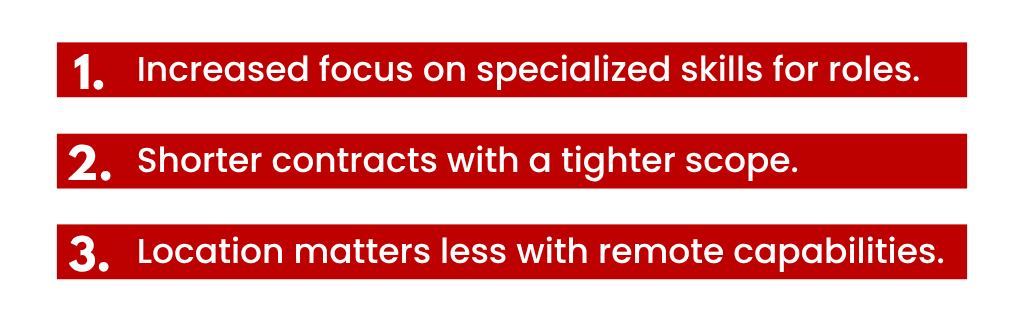
Contract jobs are no longer concentrated on low-skill or entry-level work. Demand is strongest for roles with defined expertise and deliverables.
According to the BLS Occupational Outlook Handbook, occupations with strong contract participation include information technology, engineering, healthcare support, data analysis, and business operations. These roles lend themselves to project-based work and measurable outputs.
This shift forces hiring teams to evaluate contract workers differently. Technical competence and proven execution matter more than tenure or cultural fit.
Contracts Are Shorter and More Tightly Scoped
Contract durations are shrinking. Many engagements now run three to six months with specific performance expectations written into the agreement.
Shorter contracts reduce employer risk but increase pressure on workers to deliver quickly. Contractors are expected to contribute within weeks, not months. Those who fail to ramp up fast are replaced without hesitation.
This trend favors experienced contract workers who can step into unfamiliar environments and produce results with minimal direction.
Location Matters Less Than It Used To
Remote work remains a significant part of how Americans work. BLS added telework questions to the Current Population Survey and reports that a meaningful share of employed workers continue to telework or work at home for pay.
For contract hiring, this expands the talent pool and increases competition. Employers can source nationally, but contractors also compete against a broader field. Pay differences between regions still exist but continue to narrow.\
How Contract Workers Are Responding
Contract workers in 2026 approach their careers as a series of engagements rather than a linear progression.
Skills and recent project outcomes carry more weight than job titles. Certifications and short-term training often replace formal degrees as signals of competence.
Experienced contractors often charge higher day or hourly rates than salaried employees in similar work, especially in consulting and other high-skill roles. The tradeoff is income stability: freelancing comes with uneven demand, fewer benefits, and real business costs that employees do not carry.
As a result, many contractors prioritize repeat engagements with the same companies. This reduces downtime and lowers the cost of finding new work, even if each contract remains time limited.
Compliance Risk Is Reshaping Contract Staffing
Worker classification has become a central issue in contract hiring.
The U.S. Department of Labor continues to clarify standards under the Fair Labor Standards Act for determining whether a worker qualifies as an independent contractor. Misclassification can result in fines, back pay, and legal exposure.
To reduce risk, many companies are shifting away from direct contractor relationships. Instead, they use contract staffing firms or employers of record that assume compliance responsibility.
This increases per-hour costs but reduces legal uncertainty. In regulated industries, the tradeoff is often justified.
Contract Hiring as a Financial Planning Tool
Finance teams now treat contract staffing as a budgeting lever rather than an operational workaround.
Federal Reserve Bank of St. Louis data show that labor compensation accounted for about 58.3% of total costs in the U.S. business sector in 2024, making labor the largest component of business expenses.
Contract hiring allows companies to align labor spending with revenue more precisely. Projects tied to growth initiatives or regulatory deadlines are funded. Open-ended roles without clear output are delayed or eliminated.
This financial discipline affects how hiring managers write job scopes and justify headcount. 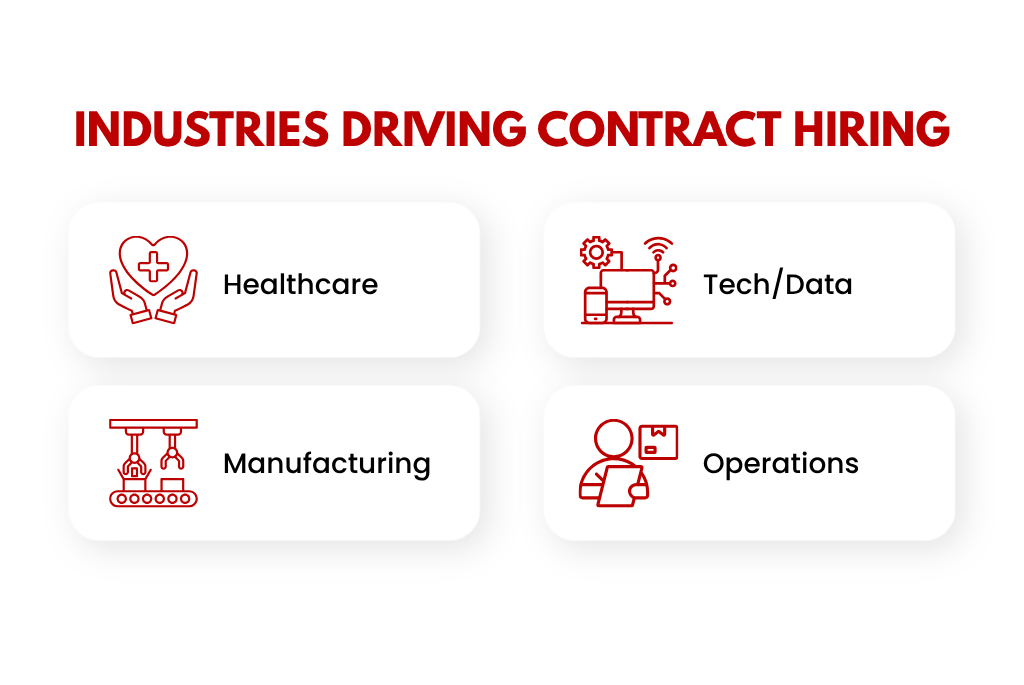 Industries Driving Contract Hiring Demand
Healthcare continues to rely heavily on contract staffing due to chronic shortages and unpredictable workload. Demand remains steady for clinical support, administrative, and technical roles.
Technology and data roles follow closely. Rapid changes in tools and platforms make permanent hiring risky when skills may be obsolete within a few years.
Manufacturing and logistics show cyclical contract hiring tied to production volume. Staffing rises during demand spikes and contracts quickly when volumes normalize.
Professional services and internal operations roles are a growing area of contract use. Companies increasingly contract program managers, compliance specialists, and analysts for defined initiatives instead of building permanent teams.
What Hiring Teams Must Adjust in 2026
Hiring teams working with contract workers face tighter margins for error.
Poorly defined roles lead to misaligned expectations and early termination. Vague scopes increase churn and waste money.
Teams that perform well maintain active contractor pipelines and standardized role definitions. They engage talent before projects are fully approved to avoid delays.
Speed and clarity determine success more than the volume of applicants.
Where Contract Staffing Partners Fit
For many organizations, managing contract hiring internally is inefficient.
Contract staffing partners provide access to pre-vetted talent, manage compliance, and reduce administrative burden. They also bring market visibility that individual companies lack.
PeopleSolutions supports U.S. employers by structuring contract staffing programs that align with actual business needs. This includes defining scopes, managing classification risk, and maintaining consistent access to qualified contract workers across industries.
The result is fewer rushed hires and more predictable outcomes across contract engagements.
What To Expect Beyond 2026
Two trends will continue shaping contract hiring.
First, better data. Government agencies are publishing more detailed information on alternative work arrangements. This will force more disciplined workforce planning.
Second, stabilized expectations. Contract workers now have clearer benchmarks for pay, flexibility, and workload. Employers that fall below market standards will struggle to attract experienced talent.
In 2026 and beyond, contract staffing rewards precision, planning, and realistic expectations.
