Blog - Independent Contractor vs Full-Time Employee: Key Differences

Hiring today isn’t just about who you bring on; it’s about how you bring them on.
Should you hire an independent contractor for flexibility and speed?
Or invest in a full-time employee for stability and long-term growth?
If you’re a business leader, HR professional, or founder, this decision directly affects your costs, compliance risk, culture, and ability to scale. And if you get it wrong, the consequences can be expensive.
At PeopleSolutions, we see this question come up constantly. Companies want to stay agile without exposing themselves to legal or tax issues, and workers want clarity around pay, benefits, and job security.
This guide breaks it all down in plain English; no legal jargon, no fluff, just a clear, practical comparison so you can make the right call.
Why the Independent Contractor vs. Full-Time Employee Question Matters
At first glance, the difference seems obvious:
- Contractors = flexible
- Employees = stable
But the real distinction goes much deeper.
Misclassifying a worker, even unintentionally, can lead to:
- Back taxes and penalties
- Wage and hour violations
- Legal disputes and audits
- Damage to your employer brand
On the flip side, choosing the right classification helps you:
- Control labor costs
- Scale faster
- Attract the right talent
- Stay compliant
That’s why understanding the difference between an independent contractor and a full-time employee is essential for business.
What Is an Independent Contractor?
An independent contractor is a self-employed individual or business hired to perform specific work or services.
They’re not on your payroll. And they don’t operate under the same rules as employees.
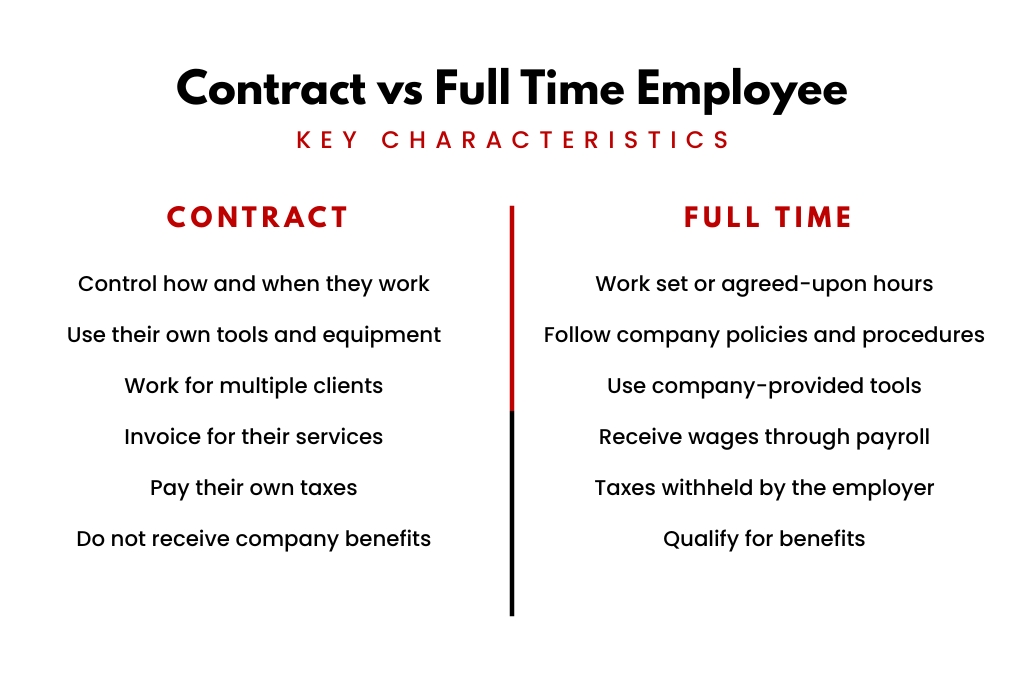
Key Characteristics of an Independent Contractor
Independent contractors typically:
- Control how and when they work
- Use their own tools and equipment
- Work for multiple clients
- Invoice for their services
- Pay their own taxes
- Do not receive company benefits
In short, contractors run their own business; you’re just one of their clients.
Common Independent Contractor Roles
You’ll often see contractors in roles like:
- IT and software development
- Marketing and design
- Consulting and advisory services
- Construction and skilled trades
- Project-based professional services
These roles usually involve defined deliverables rather than ongoing responsibilities.
What Is a Full-Time Employee?
A full-time employee works directly for your company on an ongoing basis.
They’re part of your organization; not an external vendor.
Key Characteristics of a Full-Time Employee
Full-time employees typically:
- Work set or agreed-upon hours
- Follow company policies and procedures
- Use company-provided tools
- Receive wages or salary through payroll
- Have taxes withheld by the employer
- Qualify for benefits
They’re integrated into your operations and accountable to management.
Common Full-Time Employee Roles
Full-time employees are common in:
- Operations and administration
- Sales and customer service
- Management and leadership
- Core technical or production roles
- Long-term strategic positions
If the role is central to how your business runs day to day, it usually belongs here.
Independent Contractor vs. Full-Time Employee: The Core Differences
Let’s break this down where it really matters.
Control and Autonomy
This is the biggest distinction.
- Independent contractor: Controls how the work gets done
- Full-time employee: Follows employer direction and supervision
If you’re dictating schedules, methods, and workflows, you’re leaning toward an employee relationship.
Payment Structure
- Independent contractor: Paid per project, milestone, or invoice
- Full-time employee: Paid hourly or salaried on a regular schedule
Contractors don’t receive overtime, bonuses, or payroll processing.
Taxes and Withholdings
- Independent contractor: Pays their own income and self-employment taxes
- Full-time employee: Employer withholds taxes and contributes to payroll taxes
This is one area where misclassification causes the most problems.
Benefits and Perks
- Independent contractor: No benefits required
- Full-time employee: Often eligible for health insurance, PTO, retirement plans, and more
While contractors may charge higher rates, employers avoid benefit costs.
Job Security
- Independent contractor: Engagement ends when the contract ends
- Full-time employee: Ongoing employment with protections under labor laws
Employees have more legal rights and expectations of continuity.
The Pros and Cons of Hiring an Independent Contractor
Hiring an independent contractor can be a smart move but only in the right situation.
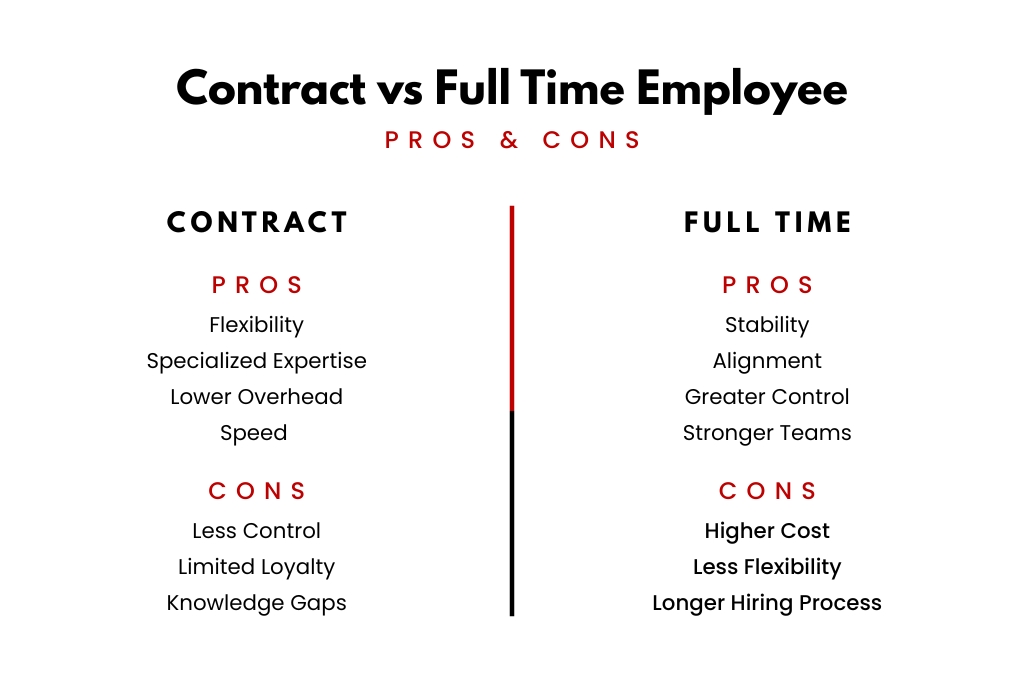
Pros of Independent Contractors
Flexibility
You can scale work up or down quickly without long-term commitments.
Specialized Expertise
Contractors often bring deep expertise for niche or short-term needs.
Lower Overhead
No benefits, payroll taxes, or long-term obligations.
Speed
You can onboard contractors faster than full time employees.
Cons of Independent Contractors
Less Control
You can’t manage contractors the same way you manage employees.
Limited Loyalty
They may prioritize other clients.
Compliance Risk
Misclassification can lead to serious penalties.
Knowledge Gaps
When the contract ends, so does access to their expertise.
The Pros and Cons of Hiring a Full-Time Employee
Full-time employees are an investment but often a necessary one.
Pros of Full-Time Employees
Stability
Employees provide continuity and institutional knowledge.
Alignment
They’re more invested in your mission, culture, and long-term goals.
Greater Control
You can define priorities, schedules, and processes.
Stronger Teams
Employees collaborate easily and build relationships over time.
Cons of Full-Time Employees
Higher Cost
Salary, benefits, payroll taxes, and onboarding add up.
Less Flexibility
Scaling down is harder and riskier.
Longer Hiring Timelines
Recruiting and onboarding take time.
How the IRS and Labor Laws View the Difference
Here’s the part many companies overlook.
You don’t get to choose whether someone is an independent contractor or a ull-time employee based on preference alone.
Regulators look at:
- Behavioral control
- Financial control
- Relationship type
If a worker functions like an employee, they’ll likely be classified as one regardless of what the contract says.
That’s why companies partner with experts like PeopleSolutions to structure engagements correctly from the start.
When Should You Choose an Independent Contractor?
Hiring an independent contractor makes sense when:
- The work is project-based
- You need specialized expertise
- The role is temporary
- The worker controls how the work is performed
- You don’t need long-term availability
If the work has a clear beginning and end, a contractor is often the right fit.
When Should You Choose a Full-Time Employee?
A full-time employee is usually the better option when:
- The role is core to your business
- You need consistent availability
- You want long-term growth and development
- The work requires close supervision
- Culture and collaboration matter
If the role impacts revenue, customers, or operations every day, hire an employee.
Common Mistakes Companies Make
Here’s where businesses get into trouble:
- Using contractors for permanent roles without intention of hiring them
- Relying on contracts instead of actual working conditions
- Ignoring state-specific labor laws
Avoiding these mistakes protects both your business and your workforce.
How PeopleSolutions Helps You Get It Right
At PeopleSolutions, we help companies navigate workforce decisions with clarity and confidence.
Whether you’re:
- Structuring contractor relationships
- Expanding your full-time team
- Scaling rapidly without compliance risk
We help you choose the right model, document it correctly, and stay aligned with regulations so you can focus on growing your business. While PeopleSolutions specializes in contractor roles, we can also help you expand your full-time team using our partner companies like WorkRocket or The Richmond Group USA.
Final Thoughts: Which Is Right for You?
There’s no universal answer.
The right choice depends on:
- The nature of the work
- Your business goals
- Risk tolerance
- Budget
- Long-term strategy
An independent contractor offers flexibility and speed.
A full-time employee offers stability and growth.
The smartest companies don’t default to one; they choose intentionally for each role.
And when in doubt, partnering with experts like PeopleSolutions can save you time, money, and headaches down the road.
If you’re evaluating your workforce model and want a clear, compliant path forward, now’s the time to get it right.
